The New Space Economy is Already Being Tokenized
For decades, the space industry was an exclusive club. If you didn’t have a few hundred million dollars for a satellite constellation—or the backing of a major government agency—you were effectively grounded. Launch programs are often defined by high upfront costs, long waits for returns, and a frustrating lack of liquidity once capital is committed.
Space asset tokenization is one attempt to bring the logic of markets into orbit: making certain space-linked assets or service entitlements easier to fractionalize, transfer, and finance across a broader base of participants.
The “New Space” Economy
The global space economy has experienced robust expansion, reaching a total valuation of $613 billion in 2024. This figure represents a nearly 48% increase over the $414.75 billion in 2018. The market's composition highlights a decisive shift toward the private sector, with commercial activity now commanding a 78% share of the total economy, while government spending accounts for the remaining 22%.
How does tokenization enter the picture?
Payloads
Copernic Space is the first company to tokenize space assets. Its goal is to help finance the new space era by tokenizing ownership of payloads, enabling not only the financing of projects but also the trading of assets that have already been launched. Given the technical complexity and the costs involved, the ability to divest represents a game-changing shift for companies and research institutions involved in space activity.
Launch vehicles
MoonDAO has made its roadmap public to raise funds aimed at acquiring major launch vehicles (such as SpaceX’s Starship). By pooling capital from thousands of members, the DAO can negotiate large-scale launch contracts or take an equity stake in the hardware itself, reducing the cost per kilogram for its members.
Orbital rights and spectrum capacity
The geostationary orbit belt is a finite natural resource. Satellites cannot be placed just anywhere: they must occupy specific orbital positions to avoid collisions and radio interference. These positions are assigned by the International Telecommunication Union (ITU) to national administrations.
New platforms are positioning themselves around market infrastructure for space-linked commodities and services. Space Markets describes itself as a trading platform focused on bringing price discovery and transparency to satellite spectrum access, including “spot market” mechanisms for underutilized bandwidth and on-chain settlement.
Data Centers Are Meant for Space
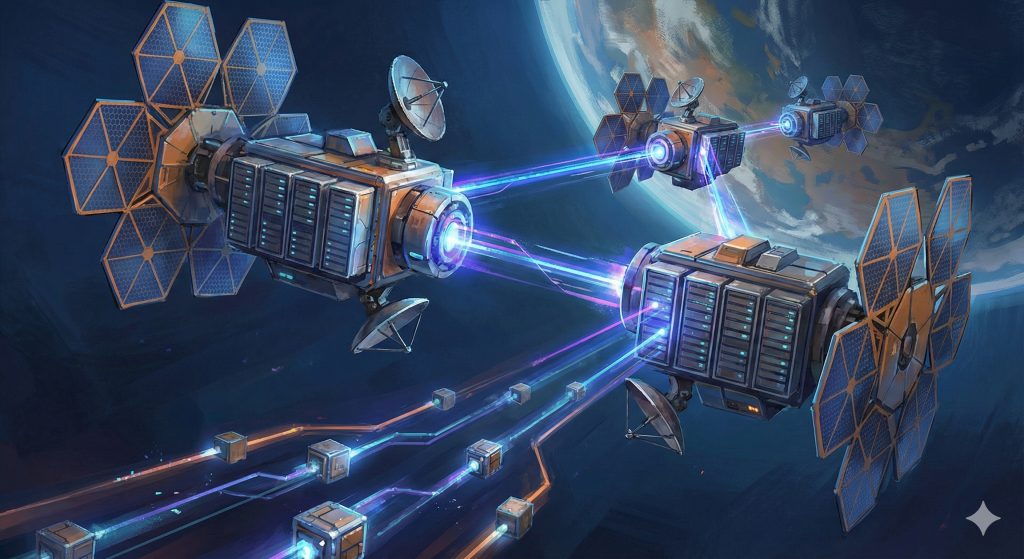
Orbital computing is set to become a ke driver of the New Space economy.
Blue Origin has been developing technology for AI data centers in space for over a year, and Bezos envisions gigawatt-scale data centers in space in the long term. Companies such as PowerBank and Orbit AI, as well as Starcloud, are also working on this, and SpaceX is expected to join them.
Start with power. In orbit, solar energy is always available. Supply is predictable, and dramatically much cheaper than on the ground. No need for a battery to store renewable energy, no need to build a mini nuclear energy plant next to the data center. Energy supply is a large portion of a data center cost.
Then there’s cooling. On Earth, a painful feature of data centers is the technical complexity of getting rid of heat. In space, temperature is close to absolute zero and you don’t need NASA levels of technology to protect the hardware from overheating. Current research indicates that a radiator attached to the side of the satellite that isn’t facing the sun could solve this issue much more effectively.
There is also connectivity. Modern data centers are really networks of computers. On Earth, racks are tied together by fiber optics, which is fundamentally a laser technology. Connectivity via fiber cables can be extremely fast but, by definition, it’s slower than lasers traveling through vacuum. Additionally, satellites can connect directly to our devices, instead of routing data through terrestrial networks with multiple touch points, making communication even more efficient, as proven by Starlink.
Deep Space Latency
There is even work on protocols to enable blockchain synchronicity between Earth and Mars. A signal to Low Earth Orbit takes milliseconds. To the Moon, it takes ~1.3 seconds (2.6s round trip). To Mars, it takes minutes.
Blockchains rely on network synchronization. Transactions in most blockchains fail if the network latency exceeds the block time. A standard blockchain node on Mars can hardly sync with Earth; by the time the block arrives, the chain has probably moved on. That’s why engineers are developing Delay-Tolerant Networking (DTN) protocols and sharding architectures.
In this model, a "Mars Shard" would run a local consensus loop and settle the final state to the Earth mainnet asynchronously, effectively creating a "Layer 3" blockchain ecosystem for deep space.
The future of financial markets
Regulated infrastructure for tokenized assets
Invest in tokenized financial instruments with full legal recognition and 100% digital

Account successfully verified!